

Anti Generative AI Policy - October 13th 2026
Since launching our studio two years ago, usage of generative AI in creative and non creative fields has exploded. We’ve seen this in a backdrop of a video game industry where thousands of developers are struggling to find work amidst mass layoffs.
We’ve seen it get harder to discern when generative AI is being used to make assets in video games.
Longdue is committing and confirming the non usage of generative AI techniques in the creation of Hopetown, and is setting out a process behind something we’re calling a Certificate of Human Creation (CHC).
A CHC is essentially a third-party verified evidence bundle that logs at different time stages, proof of the human involvement in the iterative process of making key elements of a video game, and locks that proof in a public repository.
For example, the art for interior and exterior locations in Hopetown is painstakingly created in a process that involves concept artists, writers, 3d modellers, 2D texturing specialists, lighting and level designs.
Logging the phases of creation of an area
Below, we walk through an example of extracts from a CHC in the creation of a specific interior area of Hopetown. The first stage is a proposed level design for the area.

The area is then expanded in a concept by a 2D artist.

The area is then modelled by a 3D artist.

The most intensive part of the process, taking weeks, is the texturing or ‘hand painting’ in detail over the image. The below ‘before’ and ‘after’ image shows approximately 3 weeks of full-time (120 hours) of dedicated painting of the texture by a full-time artist.


An actual time-lapse of texturing of an area can be seen below, with a human artist painstakingly added features: https://drive.google.com/drive/folders/1KSyPySh0HsljnwtdzeLkedwFAk1Hibqw?usp=drive_link
Time logged and locked-for-editing versions of the above assets are submitted to a third party, checks are carried out to determine the authenticity of each asset and element, and these are then logged in a growing CHC repository, for a selection of major areas in the game.
Logging the phases of creation of writing
It has become notoriously difficult to determine whether writing has been generated by AI or hand written. Luckily, in our development, massive usage of a tool called ‘Articy’ is in force, which is used by all writers to write the branching dialogue trees and structures. An example snapshot of such a structure is below.

As Articy requires a writer to write text ‘node by node’, it generates a time stamped proof of iteration with every written dialogue. The writing process itself is iterative, requiring substantial edits and feedback, which we carry out with a tool called YouTrack.
Shown below is a dialogue drafted by Martin Luiga in the team. The dialogue tree structure is exported from Articy to YouTrack, and then comments for editing are given visually as shown by the three ‘bubbles’ in the dialogue below. These are timestamped and stored in Workflow.

This proof of human iteration and editing is logged for major dialogues in our CHC, as for art, confirming the human creation and editing of all dialogues.
Logging the phases of creation of music
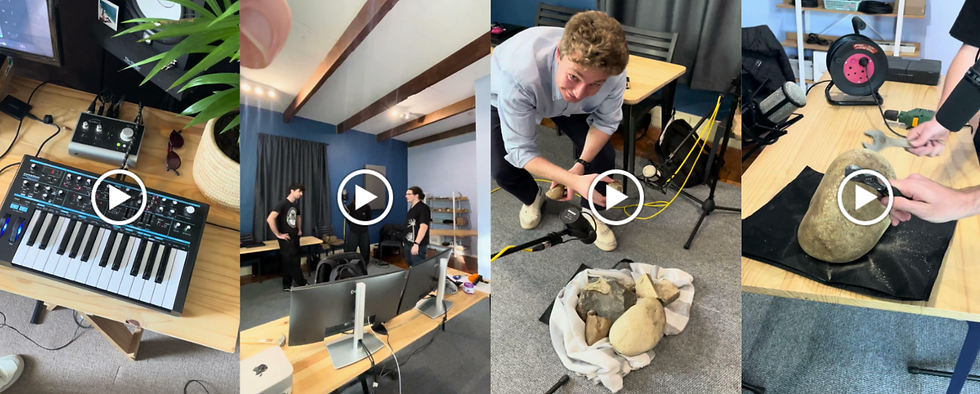
We’re making significant use of real-life recordings and the creation of music through live recordings in a studio. We’ve found the best way to document this for the CHC is to actually record in videos, how sounds have been created. Below are some example preview videos we’re storing in the CHC as proof of this.
Want to document the creation of your game in a CHC?
There are additional underlying workflows and techniques to ensure the ongoing flow of information into the CHC, and Longdue seeks to set up an independent council comprising game developers and experts from industry to oversee the CHC process and independent checks on development assets, and to establish a ‘rating’ system for video games to report on the scale of AI usage in its development (think of an analogue to the ESRB rating system).
We’re still early in this process and also note that there are methods of using technology and code to automate parts of the checks. But we don’t believe AI itself should be used to detect AI, and that human verification should always in itself be the main part of the finalisation of a CHC and AI-rating for a game.
If you’re interested in collaborating with us on this, or learning more about our CHC process, reach out on team@longduegames.com.
Until next time,
— The Hopetown Team


